
October 12, 2025
When you walk through a plant floor, you might see rows of gray control cabinets humming along quietly. What you don’t see are the engineering details inside those cabinets that keep your operations safe, efficient, and online. For engineering-savvy operations professionals – plant managers, controls engineers, automation leads – these hidden factors are the architecture of reliability. And they’re exactly what a UL 508A Certified Panel Shop focuses on. UL 508A is the gold standard for industrial control panel safety in the U.S., providing a foundation for industrial automation reliability by enforcing rigorous design and build practices.
In this article, we pull back the cover on UL 508A panel construction – from conductor sizing and enclosure ratings to wiring traceability and cooling – to show how doing it right the first time (“Do it once, do it right”) leads to superior reliability, safety, and long-term cost savings for your electrical control systems.
Conductor Sizing and Current Capacity
One of the most critical (and invisible) elements of a reliable control panel is proper conductor sizing. Every wire inside a panel must be sized not just to carry its normal load, but to handle surges and continuous current without overheating. UL 508A-certified panel shops follow strict guidelines (harmonized with NFPA 70 NEC) to ensure each conductor’s ampacity is sufficient with a healthy safety margin.
For example, feeder and motor wires are typically sized to 125% of the full-load current or more to account for startup surges and prevent insulation breakdown. Using an undersized wire might not be obvious to the eye, but it can lead to excessive heating, voltage drops, and ultimately wire failure or fire risk.
By adhering to UL 508A’s wiring standards, an in-house panel shop makes sure no wire is underspecified for its circuit. This means your panel’s internal wiring runs cool under load and lasts for decades of service. It also ensures compliance with code – an improperly sized wire would cause the panel to fail UL inspection due to the overheating and safety hazard it poses.
In short, correct conductor sizing is the backbone of reliability: it prevents unplanned downtime from burned wires and protects your equipment from electrical fires or nuisance trips. When your control panel is built by a UL 508A shop, you can be confident that every cable and connection is robust enough to handle the current now and any foreseeable future expansion of that circuit.
Enclosure Ratings and Environmental Protection (NEMA/IP)
Another “hidden” reliability factor is the enclosure itself – the box that protects all those internal components. Not all metal boxes are created equal. A UL 508A panel shop will carefully choose an enclosure with the appropriate NEMA or IP rating to suit the environment, and then build or modify it in a way that maintains that protection.
For instance, a control panel in a food & beverage plant might need a NEMA 4X stainless steel enclosure to withstand washdown and corrosion. In a dusty factory, a NEMA 12 enclosure might be selected to keep out dirt and fibers. The enclosure’s job is to shield sensitive electronics from water, dust, heat, and even physical impact – all of which can cause failures if not accounted for.
UL 508A goes beyond just picking the right box; it ensures that any cutouts or modifications to the enclosure (for pushbuttons, cable entry, fans, etc.) do not compromise its environmental rating. Certified panel builders use UL-approved gaskets, glands, and filters to uphold the NEMA/IP rating after customization. Every component mounted on the outside of the panel must carry a UL Type rating equal to the enclosure’s rating, guaranteeing it has been tested for that environment.
For you, the operations manager, this attention to enclosure rating translates into reliability and safety. A properly sealed and rated panel won’t let dust cake onto circuit boards or water seep into live terminals. It prevents environmental conditions from causing short circuits or corrosion. It also ensures compliance with OSHA and local codes. In short, a UL 508A panel shop makes sure your custom control panel fabrication is housed in an envelope that can stand up to the real-world conditions of your facility – whether that’s a scorching foundry, a chilled food warehouse, or a rainy outdoor site.
Labeling, Documentation, and Traceability
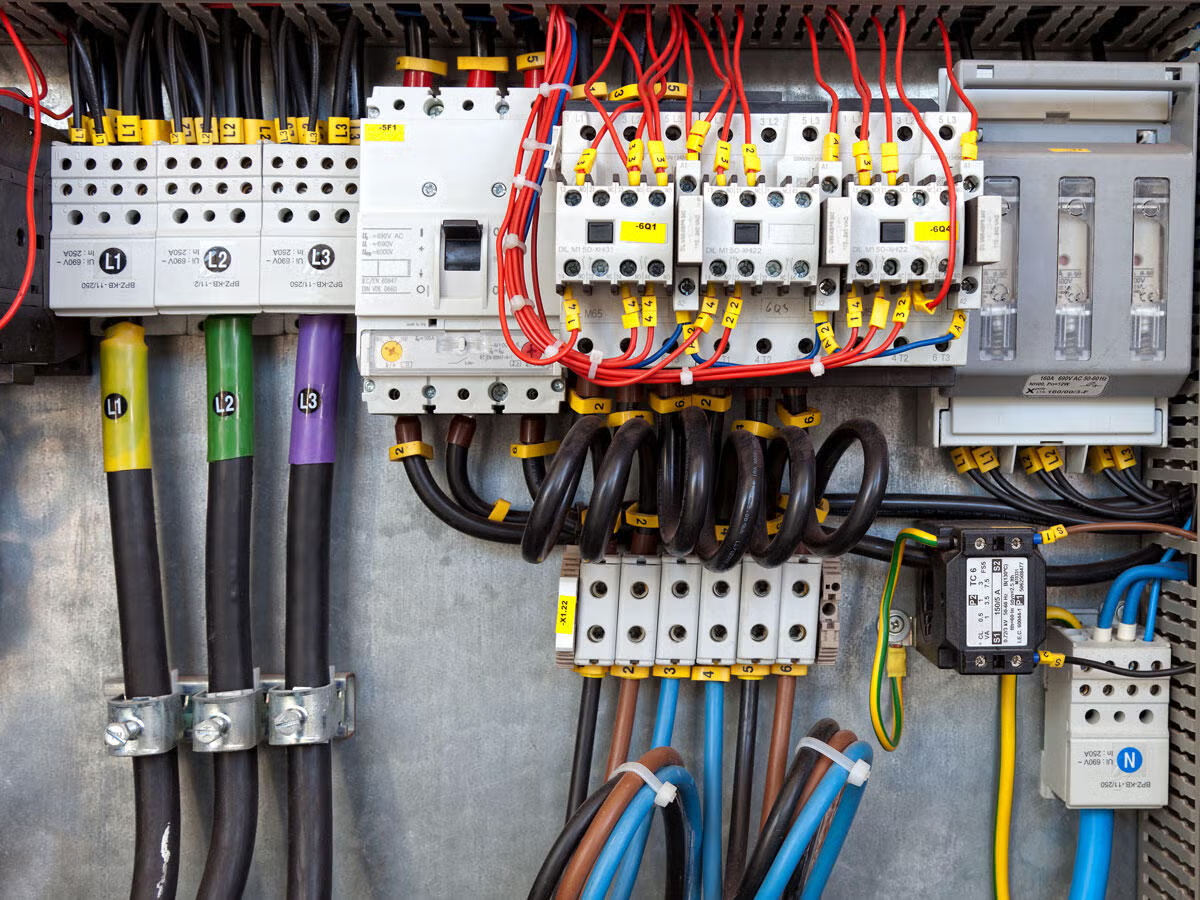
Imagine opening a control cabinet and finding a rats’ nest of unlabeled wires – a nightmare for troubleshooting and a liability for safety. UL 508A certified panels avoid that entirely through rigorous labeling and documentation practices.
Every UL panel comes with a permanent nameplate listing vital information: the panel builder, supply voltage, short-circuit current rating (SCCR), full-load currents, and more. Inside, every device – from breakers to relays – carries a clear identifier label, and every wire is numbered or color-coded to match the supplied electrical drawings. This level of detail provides end-to-end traceability for the life of the panel.
In fact, traceability is a cornerstone of UL 508A compliance. The panel shop keeps documentation of all components used (each must be UL-listed or recognized), and UL inspectors can audit those records to verify compliance. You, as the end user, benefit from a complete documentation package that includes schematics, bills of material, wire lists, and manuals. UL 508A also requires detailed installation instructions, conductor specifications, torque requirements, and more – ensuring the panel can be properly installed and maintained by qualified personnel.
From an operations perspective, this thorough labeling and documentation means faster maintenance and less downtime. Technicians can quickly identify and replace a failed component rather than guesswork. Clear warning labels keep personnel safe. A UL 508A panel shop delivers transparency, organization, and accountability – all contributors to higher reliability and lower lifecycle costs.
Internal Cabinet Temperature Control
Heat is the silent killer of electrical components. Inside a packed control panel, you have power supplies, drives, relays, and CPUs all generating heat. Without proper thermal management, the internal temperature can soar, leading to tripped circuits, premature component failures, or degraded performance.
UL 508A addresses this by requiring panel designs to account for worst-case ambient temperatures and heat rise. Industrial control panels must operate in an ambient up to 104 °F (40 °C) unless otherwise noted – a standard that forces engineers to design for high-heat scenarios. Certified panel shops perform heat calculations and incorporate cooling measures to meet this requirement.
What does this look like in practice? Components are spaced to minimize hot spots, heat-producing devices like VFDs are separated, and ventilated wiring ducts promote airflow. Many panels rely on natural convection, while more demanding environments require fans, air conditioners, or heat exchangers.
The bottom line: a UL 508A panel builder takes heat management seriously. High temperatures cause sensitive equipment to malfunction or shorten its lifespan, so panels are engineered to maintain internal temperatures within safe limits. Whether through venting, fans, or air conditioning, your system remains stable under heavy production loads – and that means less downtime, fewer failures, and extended component life.
Component Spacing and Safety Margins
Cramming as much as possible into a panel might save space, but it creates reliability issues. UL 508A imposes minimum spacing requirements between electrical live parts, metal parts, and wiring to prevent shorts and overheating. Certified shops therefore lay out components with proper breathing room for both safety and cooling.
UL 508A also requires derating of components, meaning devices should be operated below their maximum capacity to create a safety margin. For example, circuit breakers shouldn’t be loaded continuously at 100% of their rating; most are limited to 80% by code. Running components at full capacity can cause overheating and stress that reduces lifespan.
By contrast, a UL panel shop will select higher-amperage breakers or distribute circuits more evenly. This results in parts that run cooler, wiring insulation that lasts longer, and fewer accidental shorts. Technicians also benefit from better access during maintenance.
Think of component spacing and margin like city planning: clear “fire breaks” between electrical elements and room to grow. A UL 508A panel might look half-empty compared to an overstuffed non-certified box – but that breathing room is intentional and vital for safety and longevity.
Grounding and Short-Circuit Protection
No control system is truly safe without proper grounding and short-circuit protection. These two elements are the foundation of every UL 508A panel.
Grounding involves bonding all metal parts and establishing a low-resistance path to earth for fault currents. Inside the panel, you’ll find a copper ground bar connecting all chassis, rails, and enclosure parts. This ensures that if a wire comes loose or a fault occurs, the current flows safely to ground instead of endangering people or equipment.
Equally important is Short-Circuit Current Rating (SCCR). The SCCR defines the maximum fault current the panel can safely withstand. UL 508A requires this rating to be clearly labeled. Achieving a high SCCR involves selecting the right fuses, breakers, and component combinations so that a fault will be cleared safely without damaging the panel.
A UL 508A shop will perform a short-circuit analysis during design, ensuring all branch circuits and protective devices are properly coordinated. The result is peace of mind: in the event of a fault, the system trips safely instead of exploding or catching fire. That’s reliability you can trust.
Built for Future Expandability
Industrial automation evolves. A UL 508A panel designed by an in-house team is engineered with future growth in mind. Experienced engineers allocate extra space on subpanels or DIN rails for expansion, include spare breakers, and often oversize ducts or power supplies to accommodate added components later.
Panels are also built with modularity and scalability in mind – standardized components, labeled terminals for “future use,” and modular PLC racks that make upgrades easy.
This forward-thinking design means your panel can be expanded or retrofitted without losing its UL 508A compliance. The same documentation, labeling, and safety standards carry forward. As your operation grows, your control system grows with it – minimizing downtime and avoiding the cost of a full rebuild.
The In-House UL 508A Panel Shop Advantage – “Do It Once, Do It Right.”
All these benefits come together when you partner with a capable in-house UL 508A panel shop like Embry Automation & Controls. Our philosophy is simple: Do it once, do it right.
When your control panels are built right the first time, you eliminate downstream problems – safety incidents, debugging headaches, costly retrofits, and unplanned downtime. Working with an in-house UL 508A Certified Panel Shop ensures tight quality control from design to production. The same engineers who handle your system integration and programming collaborate with the fabrication team to ensure a seamless, reliable build.
Embry also provides end-to-end lifecycle support. From remote monitoring and system integration to our Premier Service preventive maintenance package, we help ensure your operations stay running at peak performance 24/7.
A well-built UL 508A panel drastically reduces downtime, accidents, and maintenance costs while protecting personnel and assets. The productivity gains and safety assurance easily outweigh the initial investment.
Conclusion: Reliability by Design
The “hidden architecture” inside a UL 508A panel – correctly sized wires, labeled terminals, cooling paths, and safety margins – isn’t glamorous, but it’s essential. It’s what separates an ordinary control panel from a truly reliable, safe, and future-ready system.
At Embry Automation & Controls, we build U.S.-made UL 508A Certified Control Panels with an unwavering focus on reliability and precision. Every detail is engineered to perform flawlessly under demanding conditions.
Do it once, do it right – and your systems will reward you with safer operations, lower costs, and long-term peace of mind.